
Brazoria Parole and Probation Compared
Texas separates the decision to release someone from prison, state supervision after that release, and community supervision ordered by a Brazoria court. The responsible record source follows that distinction.
| Question | Parole or mandatory supervision | Probation or community supervision |
|---|---|---|
| How it begins | Release from TDCJ confinement before the full state obligation ends. | A court judgment places the person under community supervision. |
| Who decides | Texas Board of Pardons and Paroles handles release and revocation decisions. | The sentencing court imposes the judgment and conditions. |
| Who supervises | TDCJ Parole Division through the mapped district parole office. | The local Community Supervision and Corrections Department. |
| Public verification | TDCJ, IVSS, status lines, and Angleton District Parole Office. | Felony or misdemeanor docket, judgment, and authorized local CSCD inquiry. |
| How it ends | Discharge, revocation, or another official disposition. | Court-ordered completion, discharge, revocation, or modification. |
A bond release does not place someone on probation. A probation sentence does not mean the person served a TDCJ prison term. Confirm the judgment or state custody record before selecting a route.
Verify Brazoria Post-Release Supervision
Use identifiers that connect the person to the correct state or court record. A name alone is too weak when aliases and common names are possible.
- Determine whether the underlying case produced a TDCJ commitment or a Brazoria County community-supervision judgment.
- For a current state prisoner, search the TDCJ Inmate Search with a TDCJ or SID number when possible. Its online population is current-only.
- For release to parole or mandatory supervision, search TDCJ IVSS by name, SID, current TDCJ number, or former TDCJ number, then open View Details.
- Use the pre-vote parole status line at 844-512-0461 when the Board has not voted. After a favorable vote, use Review and Release Processing at 512-406-5202.
- For probation, find the felony case with District Clerk or the misdemeanor case with County Clerk, read the judgment and conditions, then contact the local supervision department through an authorized channel.
- Confirm whether the current status is active supervision, warrant, pending revocation, or discharge. Do not infer one from silence in another system.
The TDCJ public inmate search is not a complete directory of released parolees. IVSS carries the inquiry beyond prison custody because it includes parole and mandatory supervision.
Angleton Parole Office for Brazoria
Brazoria County maps to the Angleton District Parole Office in TDCJ Parole Division Region III. This is the local state supervision contact for routine parole-office routing after release.
Angleton District Parole Office
Address: 1208 N. Velasco, Angleton, TX 77515
Phone: 979-849-2461
Fax: 979-849-9279
Agency: Texas Department of Criminal Justice Parole Division
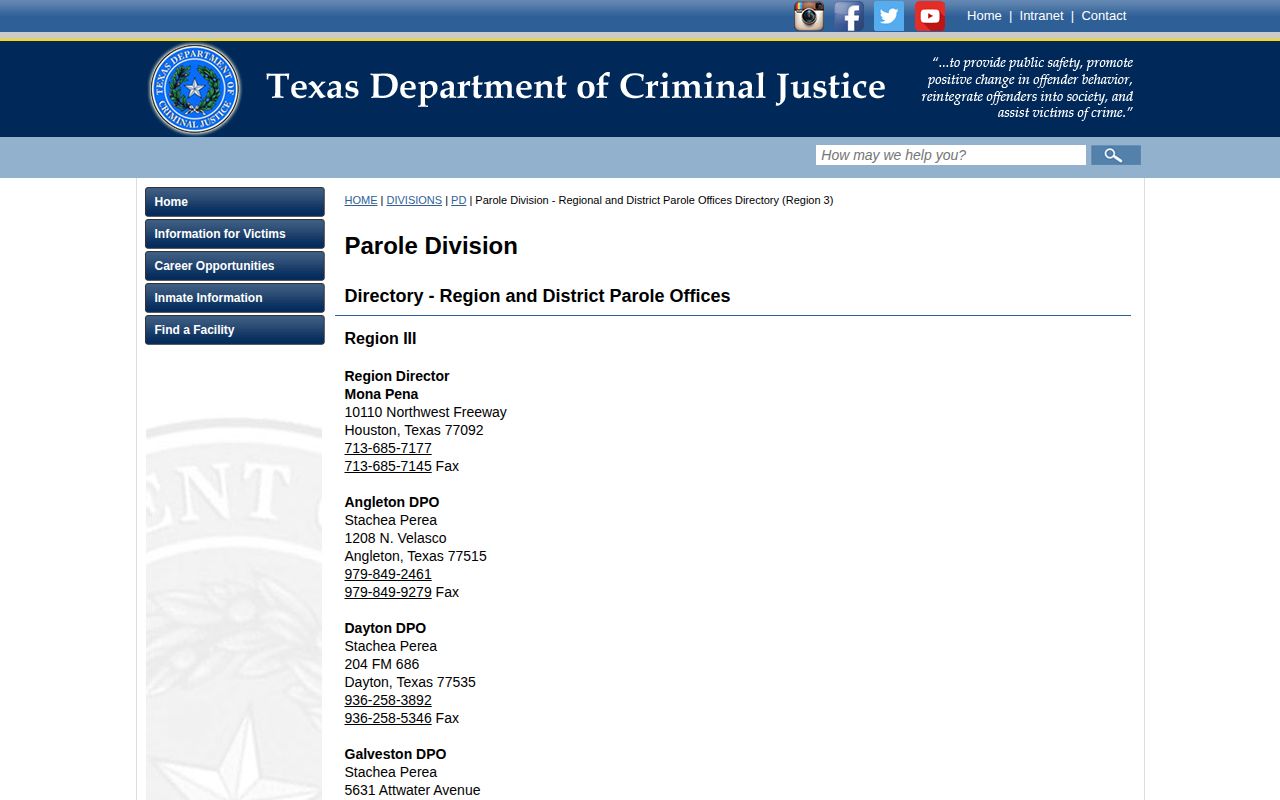
The official office page is shown below so readers can recognize the state source and current contact context.
Office staff may confirm routing while withholding private case details. Bring or provide the correct TDCJ or SID identifier and state the narrow question.
Two Angleton Offices, Two Roles
The local names can cause confusion. The Angleton District Parole Office supervises people after release. The separate Angleton Board Office handles panel decisions for assigned state units, including Clemens, Ramsey, Stringfellow, and Terrell. It is located at 209 E. Mulberry, Suite 120, Angleton, and uses 713-982-9755 and ANGBoardCorrespondence@tdcj.texas.gov.
A reader seeking a reporting office should use the DPO. A reader asking about an assigned parole decision may need the Board Office or the state status line. Neither office should be substituted for TDCJ Review and Release Processing when the question is whether staff completed physical release after a favorable vote.
Brazoria Probation Record Route
Community Supervision and Corrections Departments are organized within local judicial districts. TDCJ's Community Justice Assistance Division provides funding and oversight functions, but local CSCD employees are not TDCJ employees. Texas has no broad public probationer-name roster that works like a jail list.
Use the Brazoria court record instead. District Clerk handles felony records, and County Clerk handles misdemeanor criminal matters. Locate the case number and read the judgment, conditions, later orders, and docket entries. The court record can establish that community supervision was imposed, modified, revoked, or discharged. Contact the local CSCD only through its proper public or authorized route for current confirmation.
A jail release sheet answers when jail custody ended. It may not answer whether a later judgment placed the person on probation. The Brazoria County release-record guide explains how to reconcile the custody event with the separate court chronology.
Brazoria Supervision Warrants and Revocation
A Parole Division warrant can authorize detention for an alleged new offense, indictment, absconding, or an administrative-condition violation. The warrant remains until it is withdrawn or the person is arrested. Arrest on the warrant does not itself prove that the Board revoked parole.
Revocation administrative hearings are distinct from initial parole file review. Possible results include continued or modified supervision, an intermediate sanction or facility placement, or revocation and return to prison. Angleton Hearing Operations at 209 E. Mulberry, Suite 250, Angleton, phone 713-982-9704, performs a hearing function. It is not a public calendar for ordinary parole review.
IVSS may provide warrant and movement notices. Treat an alert as a prompt to check the official status, not as a complete case record. If custody resumes, identify the agency holding the person and obtain the related warrant or Board outcome through the correct channel.
Brazoria Release Conditions and Status
Conditions are person-specific and should be read from the official release certificate, judgment, or supervision record. At a high level, supervision can require reporting and compliance with restrictions set by the Board or court. The public record may not expose every operational detail.
Keep four statuses separate. Active supervision means the obligation continues. Warrant signals authority to detain but not a final revocation finding. Pending revocation means process remains underway. Discharge records the end of the relevant state or court supervision obligation. A new booking can coexist with any of these stages until the official record changes.
Note: Verify the source date because IVSS, court dockets, and office records may reflect different stages of one supervision event.
Correct Stale Brazoria Release Data
Texas Business & Commerce Code Chapter 109 supplies a specific route for disputes with qualifying businesses that publish criminal-record information. Section 109.004 requires an investigation of completeness or accuracy disputes, generally within 45 business days. Incomplete or inaccurate information must be corrected or removed without a fee, and the requester must receive notice of the result.
This rule can matter when a parole, probation, warrant, or discharge status has changed but a publisher still shows stale material. It does not create a right to erase accurate public information merely because jail or prison custody ended. Section 109.005 separately addresses expunction and nondisclosure, while protected juvenile information has its own limits.
First obtain the official state or court record showing the correct status. Send the publisher a focused dispute that identifies the inaccurate item and supporting record. Do not try to reconstruct sealed or expunged information from copied sources.
Brazoria Parole Review Is File-Based
Texas ordinary parole and mandatory-supervision consideration is not a public courtroom hearing. A three-person Board panel reviews case files and votes sequentially; two matching votes finalize the result. There is no offender-by-offender public hearing calendar to search. Open Board meetings are agency meetings, not daily case calendars.
Parole Division identifies cases about six months before initial eligibility and about four months before a later review date. An Institutional Parole Officer interviews the prisoner and prepares a summary. A denial notice can set a later review, while an approval may carry conditions. Eligibility opens consideration but does not prove that release will occur.
Common vote codes include FI-1 for release when eligible, FI-2 for release in a specified future month and year, program-linked FI options, RMS for mandatory supervision, NR for denial with a next review, SA for serve all, and DMS for denial of mandatory supervision with later review. Read the current official vote-options definitions because a favorable code can still precede required work and release processing.
How Brazoria Supervision Ends
Parole or mandatory supervision ends through an official state discharge or other final action, not simply because a reporting date passes or a name stops appearing in one view. Probation ends under the controlling court order and local record. A transfer between offices does not end supervision.
For state history that ordinary channels do not supply, request an existing incarceration, release, or discharge record through TDCJ Public Information at PIA@tdcj.texas.gov or its online form. For probation, request the relevant judgment, discharge order, or docket record from the correct Brazoria clerk. Ask for certification only when the receiving process requires it.
Note: A public view can lag behind the supervising office's current record.