
Brazoria Projected Versus Actual Release
TDCJ defines Projected Release Date as its Classification and Records estimate of release from the Correctional Institutions Division if parole does not occur first. The field describes a person still incarcerated in state prison. It is not a record of departure. An actual release date comes from the completed custody transaction or later release record. Those two dates may match, but the projection alone cannot prove that staff released or transferred the person.
A Brazoria County pretrial detainee is different. No sentence has yet supplied a fixed end date. Bond action, a court order, case disposition, and other holds shape the next step. Even after a judge authorizes release, jail processing and another agency's warrant may affect the physical exit. A county-sentenced inmate has a computed term, but the sheriff's calculation controls rather than TDCJ's state-prison formula.
Find Brazoria Projected Release Dates
First identify the custodian. Brazoria County contains the county detention center, short-term city jails, and five TDCJ prisons. A geographic search can therefore send a reader to the wrong authority. Clemens, Memorial, Ramsey, Stringfellow, and Terrell are state prisons. Their projected dates belong to TDCJ. A county booking belongs to BCSO and the related Brazoria court.
- Confirm whether the person is in county jail, a municipal jail, or TDCJ.
- For TDCJ, search by TDCJ or SID number when possible; otherwise use the exact last name and first initial.
- Match location, identity details, offenses, and county before reading the Projected Release Date.
- For a county sentence, locate the judgment and ask BCSO Jail Records for the sheriff's computed information and any other hold.
- Near the date, verify the live status and ask the custodian whether release, transfer, or another hold occurred.
The TDCJ Inmate Search accepts Last Name, First Name, TDCJ Number, SID Number, Gender, and Race. Last name plus a first initial, a TDCJ number, or SID supplies the basic search route. The official form shown below also states the crucial scope limit.
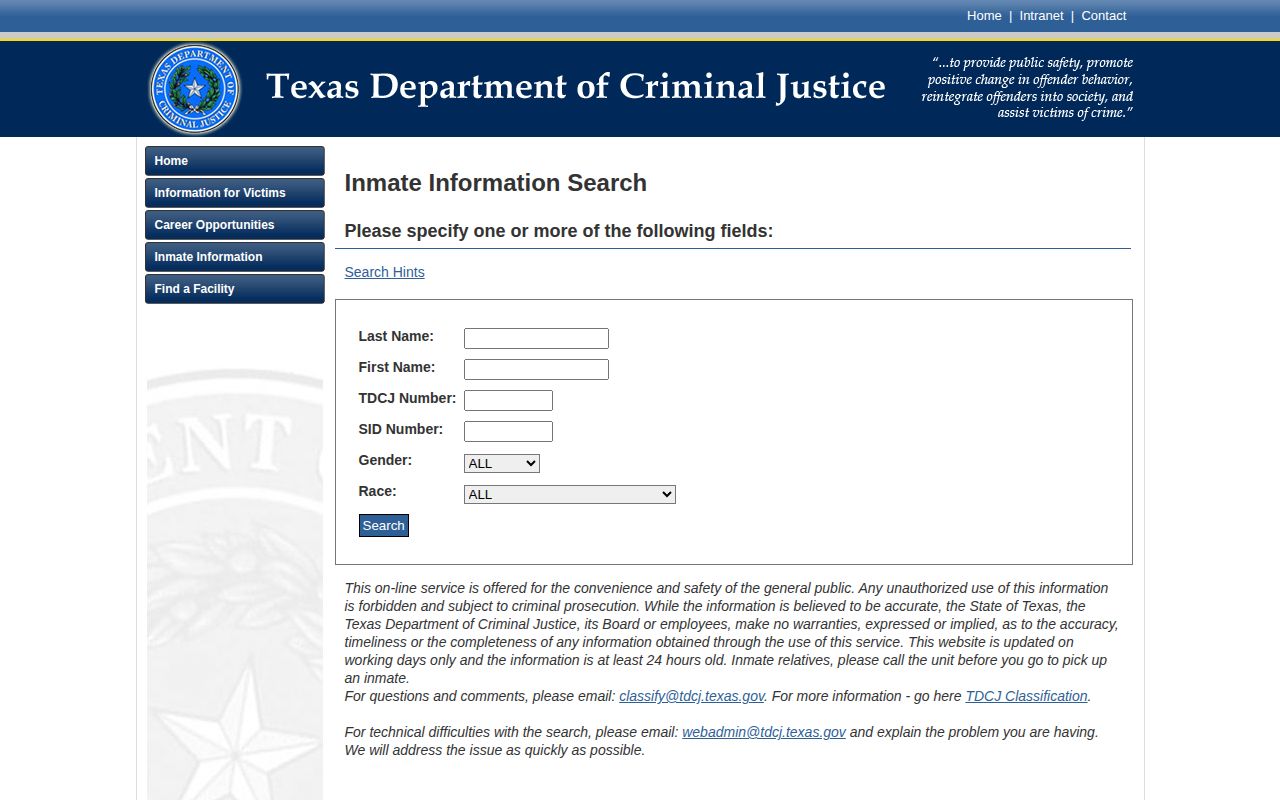
Only people currently incarcerated in a TDCJ facility appear in this public search. A missing result is not release proof. It may reflect identity mismatch, release, or a move beyond the database's stated scope. The Brazoria County released inmate search explains the local record and court checks used after a name leaves a current list.
Brazoria Release Date Backup Channels
TDCJ offers a no-charge offender-information email path. Send the full name and seven-digit TDCJ number to pia@tdcj.texas.gov. If the number is unknown, include exact birth date or approximate age and county of conviction. The response can include the TDCJ number, location, current offense and court facts, prior incarceration history, and projected date. It does not provide a photograph through this service.
General offender and location information is available at 936-295-6371 or 800-535-0283 during published weekday office hours. Exact birth date is needed when the TDCJ or SID number is unknown. Before a Board vote, parole status is available at 844-512-0461. After a favorable vote, Review and Release Processing is reached at 512-406-5202. The last line needs a TDCJ number, SID, or birth date.
Use IVSS for a person in TDCJ custody or on parole or mandatory supervision. It accepts a name, SID, current TDCJ number, or former TDCJ number and can support release or discharge notices. For an existing release certificate or full incarceration history beyond routine information, use the TDCJ Public Information Act process.
Texas Good Time Release Rules
Texas good conduct time is part of a classification system. Government Code Sections 498.003 and 498.004 address earning, loss, and possible restoration of those credits. Good time does not promise physical release. Classification changes, discipline, forfeiture, restoration, offense law, and statutory exclusions can alter the calculation.
For eligible offenses committed before September 1, 1996, TDCJ explains that projected mandatory-supervision release may occur when calendar time plus good conduct time equals the sentence. For eligible later offenses, discretionary mandatory-supervision review also applies. If the Board denies that release, the projection may move to maximum expiration or discharge. For people not eligible for mandatory supervision, TDCJ describes projection as maximum expiration based on flat calendar time.
Government Code Sections 508.147 and 508.149 contain the framework and exclusions. Section 508.149 also permits denial in qualifying later cases when credits do not accurately reflect rehabilitation and release would endanger the public. Thus arithmetic can reach a date while a required review produces no release.
Note: TDCJ credits apply to state prison calculations, not automatically to a Brazoria County jail booking or local sentence.
No Texas 85 Percent Rule
Texas does not impose a universal rule that every prisoner serves 85 percent of a sentence. Generic calculators that apply that figure to every Brazoria County case can be wrong. The offense, offense date, sentence, exclusions, calendar time, credits, and Board role must be identified first.
For cases governed by Government Code Section 508.145(d), actual calendar time without good time must equal one-half of the sentence or 30 calendar years, whichever is less, and never less than two calendar years. That is a parole eligibility threshold for its covered cases. It is not 85 percent, it is not universal, and it is not an exit date.
Eligibility only opens the point at which the Board may act. A favorable vote may still depend on a program, approved residence plan, certificates, release processing, or resolution of a detainer. New information can also affect a prior vote. The TDCJ record and governing statute are more reliable than a broad percentage rule.
Brazoria Release Dates Can Move
A projected date is recalculated as legal and custody facts change. Some events affect eligibility. Others affect the point when staff can complete release. Read the current date with its status and source, not as a promise printed once and fixed forever.
| Factor | Possible effect |
|---|---|
| Good-time loss or restoration | Changes credits used in an eligible TDCJ calculation. |
| Offense date or exclusion | Determines which parole or mandatory-supervision rule applies. |
| Board decision | May approve, defer, condition, or deny release consideration. |
| Program or release plan | Can delay processing after a favorable vote. |
| Detainer or warrant | May cause transfer to another custodian instead of community release. |
| Court order or sentence change | Can change legal authority or the term being calculated. |
A detainer is another agency's request for notice and an opportunity to assume custody. It is not itself a finding that the person entered the community. In Brazoria County, an ICE handoff is especially important because county criminal release can occur as federal immigration custody starts.
Brazoria County Jail Release Dates
No official Brazoria County jail good-time policy or weekend and holiday early-release rule was found. Do not apply state-prison credits to the county jail. Do not promise that a weekend date will become a Friday exit. The sentencing order, sheriff's calculation, and any other hold control the local path.
Search the official Odyssey Jail Records and court landing page, then call BCSO Jail Records at 979-864-2278. The jail record is strongest for the local custody transaction. A felony or misdemeanor docket can explain bond, judgment, sentence, dismissal, or a release order, but it may not show the actual physical departure time.
Ask a narrow question tied to the booking: what date does the sheriff's existing record compute, and are other holds recorded? Near the date, ask what event actually occurred. Release on bond, time served, transfer to TDCJ, and transfer to ICE have different meanings even when the county custody line closes.
Confirm Brazoria Actual Release Dates
For TDCJ, compare the current inmate record with IVSS and release-processing status. A current result plus a future projected date means state incarceration continues. A favorable parole result is still not physical-release proof. After departure, a release or discharge notice, release record, or staff confirmation supplies stronger evidence.
For local custody, preserve the booking number, case number, source URL, and observation time. Then request the existing booking and release sheet if the portal remains unclear. Match several identifiers and ask whether the outcome was community release or transfer. A court order explains legal authority, while the sheriff's record documents its execution.
A Brazoria County VINELink check can add a pending county alert, while IVSS serves the state stage. Neither alert system replaces the source record. Confirm close to the stated date because data and plans can change until the custodian completes the event.
When two sources differ, record what each one showed and when it was checked. The court may show the order time, TDCJ may show a calculated date, and the jail may record the administrative release time. The person may physically leave later or be handed to another custodian. Keeping those clocks separate avoids forcing unlike events into one date.
Identity checks matter as much as time checks. Use the TDCJ number, SID, booking number, case number, exact birth details, or several biographical fields before joining records. A common name can produce several plausible results. A photograph alone is not enough. The final confirmation should name the person, source agency, record number, status, event date, and whether the outcome was release, discharge, parole, or transfer.